
IVF vs ICSI: What's the Difference — and Do You Actually Need ICSI?
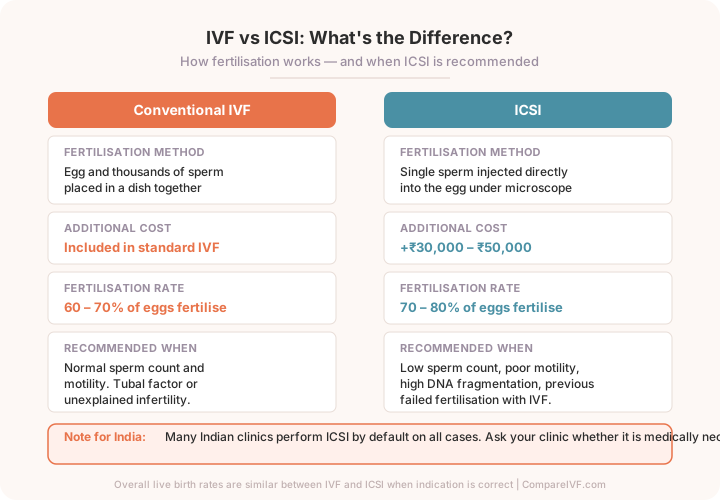
When patients get their IVF quote, they often see "ICSI" listed as a separate line item — sometimes without explanation, sometimes described as "recommended for all our patients." At ₹30,000–50,000 additional per cycle, it is worth understanding what it is and whether you actually need it.
ICSI (Intracytoplasmic Sperm Injection) is a specific fertilisation technique, not a separate treatment. Both IVF and ICSI involve the same stimulation, monitoring, egg retrieval, and embryo transfer process. The only difference is what happens in the lab on the day of retrieval.
How Conventional IVF Fertilisation Works
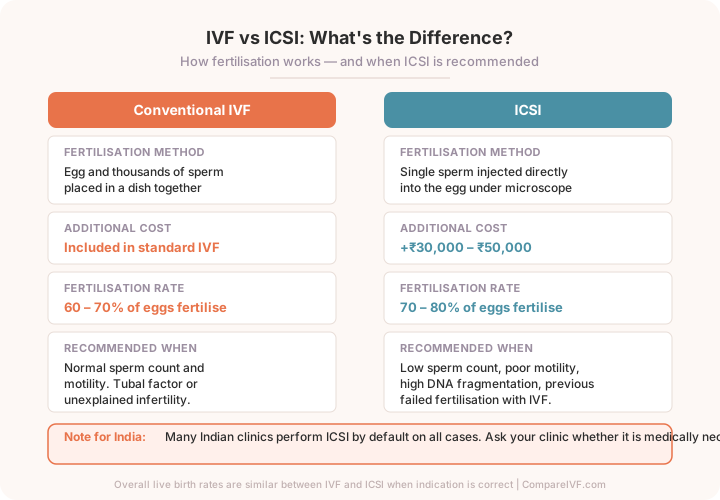
In conventional IVF, the retrieved eggs and the washed sperm sample are placed together in a culture dish. The sperm finds and penetrates the egg naturally — the embryologist simply provides the ideal environment. A normal sperm sample fertilises 60–70% of mature eggs this way. No micromanipulation is involved.
How ICSI Works
In ICSI, a single sperm is selected by the embryologist under a high-powered microscope and injected directly into the egg using a very fine glass needle. This bypasses the natural fertilisation process entirely. ICSI typically fertilises 70–80% of mature eggs. It is used when natural fertilisation is unlikely to succeed.
When Is ICSI Medically Necessary?
ICSI is clearly indicated when: the male partner has a very low sperm count (severe oligospermia), very poor motility, very few normal-shaped sperm (severe teratospermia), high DNA fragmentation, or if sperm is obtained surgically (TESA, PESA, Micro-TESE). It is also appropriate when there has been previous failed or very low fertilisation with conventional IVF, or when very few eggs are retrieved (to maximise fertilisation).
The Problem in India: ICSI as Default
In India, the majority of IVF cycles are performed with ICSI — often on every patient, regardless of sperm quality. A couple where both partners have normal fertility parameters, blocked tubes causing the infertility, may still be charged for and receive ICSI as a matter of routine. This is not evidence-based practice.
ICSI does not improve pregnancy rates in couples with normal sperm. Multiple large randomised trials have confirmed this. The additional cost and micromanipulation are justified only when fertilisation would otherwise be compromised.
Ask your clinic directly: "Is my partner's semen analysis a clinical indication for ICSI, or is this routinely offered to all patients?" If the answer is the latter, you are entitled to request conventional IVF.
Does ICSI Carry Any Risks?
ICSI is a safe and well-established technique. Large studies have found no meaningful difference in live birth rates, child health outcomes, or developmental outcomes between IVF and ICSI in patients with normal sperm. The additional risk in true male-factor cases is the underlying genetic cause of the sperm problem, not the ICSI technique itself.
The Bottom Line
ICSI is an important medical advance that has transformed outcomes for male-factor infertility. But its routine use in patients who don't need it adds cost without benefit. If your semen analysis is within normal parameters and the cause of your infertility is not male factor, conventional IVF is a legitimate and appropriate option. Ask for the evidence behind your clinic's recommendation.
About CompareIVF Editorial Team
The CompareIVF editorial team combines fertility medicine expertise with investigative journalism to help patients make informed decisions about their fertility journey.