
The "65% Success Rate" Lie: What India's IVF Clinics Aren't Telling You
Drive past any major hospital in Bangalore, Delhi, or Mumbai and you'll see it: a bright billboard, a smiling couple holding a newborn, and a bold claim — "68% IVF Success Rate."
It sounds remarkable. It's meant to.
But after reviewing international outcome data and digging through the fine print on clinic websites, one thing becomes clear: the number on that billboard is almost certainly not telling you what you think it is. This is not a story about clinics lying outright. It's a story about a metric that sounds like one thing but means something else entirely — and about an industry in India that, unlike its counterparts in the UK, US, and Australia, has no obligation to prove any of it.
The Two Numbers: What Clinics Say vs. What It Means
There are two fundamentally different ways to measure IVF success.
The first is Clinical Pregnancy Rate (CPR). This is measured at 6–8 weeks, when an ultrasound confirms a gestational sac with a heartbeat. A positive scan counts as a "success."
The second is Live Birth Rate (LBR). This is measured when a baby is actually born, healthy, and breathing. This is the number you are actually hoping for.
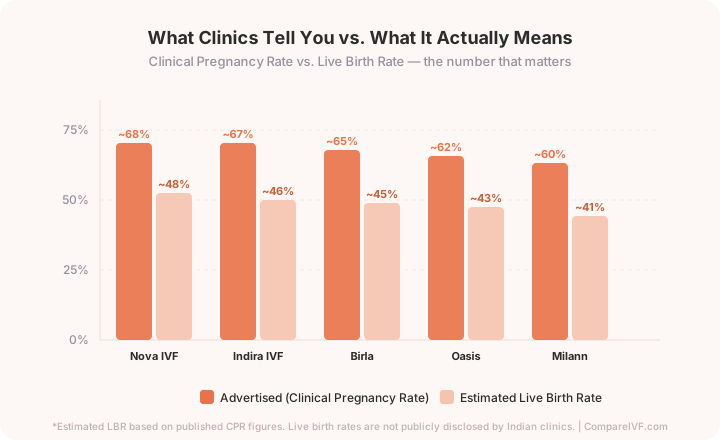
These two numbers are not the same. In fact, they can differ by 15 to 20 percentage points. A clinical pregnancy rate of 65% does not mean 65 out of every 100 patients take home a baby. Some of those pregnancies will miscarry. Some will be stillbirths. The baby who matters to you is counted only in the live birth rate.
Almost no Indian IVF clinic publishes its live birth rate.
How India Compares to the Rest of the World
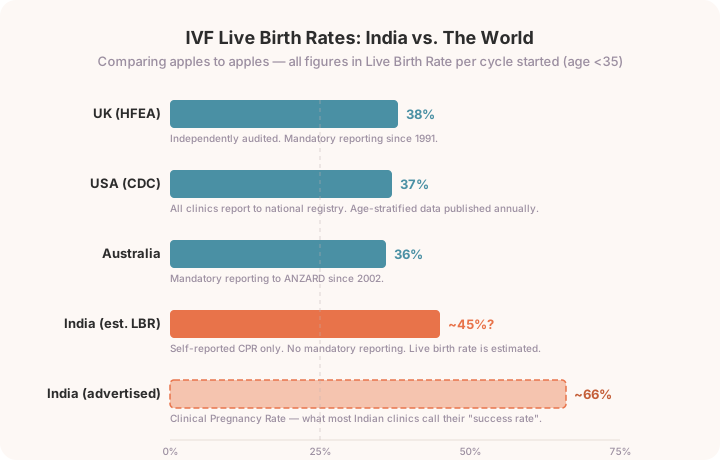
In the United Kingdom, every IVF clinic is legally required to report its outcomes to the Human Fertilisation and Embryology Authority (HFEA). The data is public, age-stratified, and audited. A clinic cannot manipulate its numbers because the government counts the babies.
In the United States, the CDC publishes an annual ART Success Rates report covering every fertility clinic in the country. In Australia, ANZARD has collected national data since 2002. These regulated markets show live birth rates of 36–38% per cycle started for women under 35.
India has no equivalent body. There is no mandatory reporting. No independent audit. No national database. Indian clinics routinely advertise "success rates" of 60–70%. These figures are self-reported, unverified, and use a different metric entirely than what international bodies publish.
The Number That Changes Everything: Your Age
Here is what the billboards never show you.
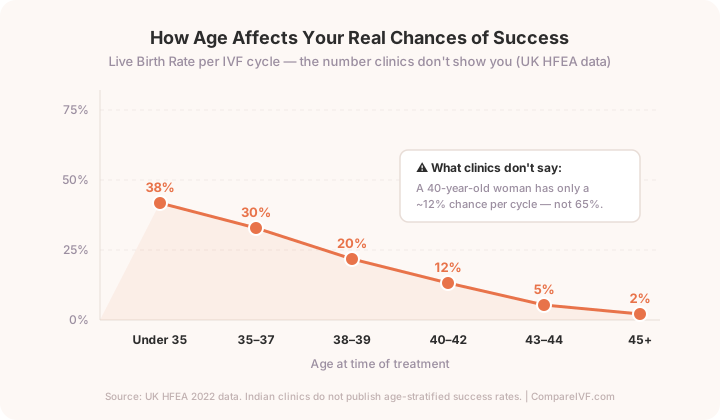
IVF success rates collapse dramatically with age. This is not a failure of medicine — it is biology. Egg quality declines sharply after 35, and more steeply after 38. The live birth rate for a woman under 35 in the UK is around 38% per cycle. For a woman aged 43–44, it falls to just 5%. For women over 45, it is approximately 2%.
Yet the headline "65% success rate" advertised by Indian clinics does not come with an asterisk that says: "This may apply to women under 35 with a good ovarian reserve." A 40-year-old woman reading that billboard is not being told that her real chance per cycle — the one that ends with a baby — may be closer to 10–15%.
Per Transfer vs. Per Cycle Started: The Other Hidden Variable
When a clinic says "success rate per embryo transfer," they are counting only the cycles that made it far enough to transfer an embryo. They are quietly excluding cycles that were cancelled — because the patient had a poor response to stimulation, because no eggs were retrieved, because no embryos survived to transfer.
Per cycle started counts everything, including the failures before the transfer. It is always lower. And it is far more representative of your actual odds when you walk through the door. A clinic that reports a 65% success rate "per transfer" might have a 50% rate "per cycle started" once cancelled cycles are included. These cancelled cycles still cost time, money, and emotional energy.
Always ask: "Is this per cycle started or per embryo transfer?"
Why This Matters: The Real Cost of Unclear Numbers
The stakes here are not abstract. An IVF cycle in India costs ₹1.5–3.5 lakh per attempt. Most patients need two to three cycles before achieving a live birth, or before concluding that IVF will not work for them. The cumulative cost of a realistic treatment journey — not the best-case-scenario journey implied by a 65% headline — can be ₹5–10 lakh. You can compare IVF clinic prices across India to understand the full picture before committing.
When patients make decisions based on inflated or misunderstood success rates, they may underestimate the total financial commitment, delay pursuing donor egg options that might give them better odds, spend years at a clinic that isn't right for their age and diagnosis, or feel a disproportionate sense of personal failure when a statistically likely outcome — not succeeding on the first cycle — occurs.
Informed patients make better decisions. They manage their expectations more healthily. They ask the right questions, choose the right clinics, and ultimately have better outcomes — not because IVF got easier, but because they understood the odds.
5 Questions Every Patient Should Ask Their Clinic
A reputable clinic will welcome these questions. A clinic that deflects or gets defensive should give you pause.
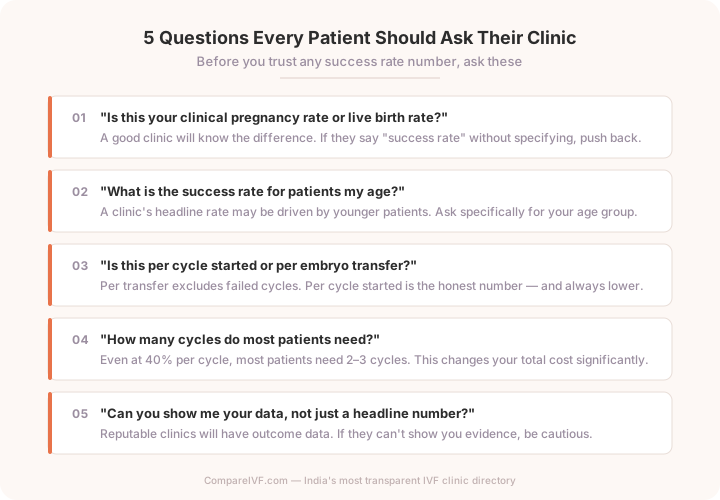
1. "Is this your clinical pregnancy rate or live birth rate?" — A good clinic will know the difference.
2. "What is the success rate for patients my age?" — Ask specifically for your age group, not the headline number.
3. "Is this per cycle started or per embryo transfer?" — Per transfer is always higher and excludes failed cycles.
4. "How many cycles do most patients need?" — Even at 40% per cycle, most patients need 2–3 attempts.
5. "Can you show me your data, not just a headline number?" — Reputable clinics will have outcome data. If they can't show evidence, be cautious.
What Needs to Change
India's ART (Assisted Reproductive Technology) Act, passed in 2021, was a landmark step. It established a regulatory framework for fertility clinics and mandated registration. But it did not create a public outcome reporting system equivalent to the UK's HFEA. What India needs — and what patients deserve — is a mandatory national registry where every clinic reports its outcomes, broken down by age, diagnosis, and treatment protocol. Where every "success rate" claim is audited against actual birth records.
Until that exists, the responsibility falls on patients to ask harder questions — and on platforms like this one to give them the tools to do so.
The Bottom Line
Before your next consultation, remember:
• "Success rate" almost always means clinical pregnancy rate, not live birth rate
• Live birth rate is typically 15–20 percentage points lower
• Your age matters more than any clinic's headline number
• Per transfer rates exclude cancelled cycles — always ask for per cycle started
• No Indian clinic is required to independently verify any of these claims
You deserve honest numbers. You deserve to make one of the most important and expensive medical decisions of your life with complete information. Browse and compare clinics in Bangalore, or book a free consultation with our fertility advisors. That's why we built CompareIVF — because transparency isn't a nice-to-have. It's the whole point.
About CompareIVF Editorial Team
The CompareIVF editorial team combines fertility medicine expertise with investigative journalism to help patients make informed decisions about their fertility journey.