
IVF Success Rate by Age: What the Numbers Actually Mean for You
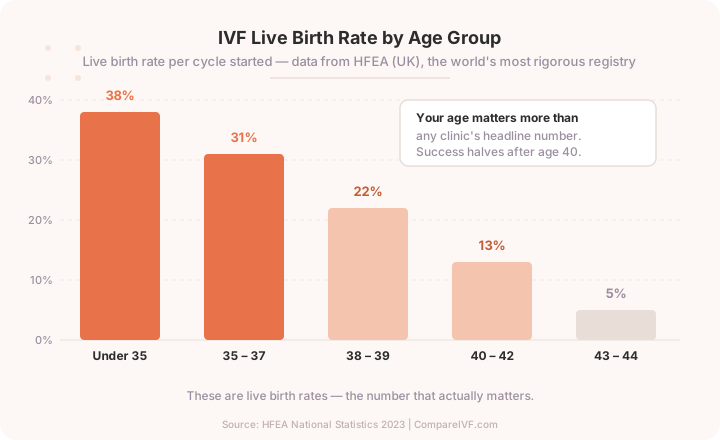
If there is one thing every patient should understand before starting IVF, it is this: your age matters more than which clinic you choose, more than how experienced your doctor is, and more than which protocol you use. Age is the single most powerful predictor of IVF success.
This is not pessimism — it is biology. And understanding it clearly will help you make better, faster, more realistic decisions about your fertility journey.
The Numbers: Live Birth Rate by Age Group
The chart above uses data from the Human Fertilisation and Embryology Authority (HFEA) in the UK — the world's most rigorous fertility outcome database. These are live birth rates, not clinical pregnancy rates. A live birth means a baby actually came home.
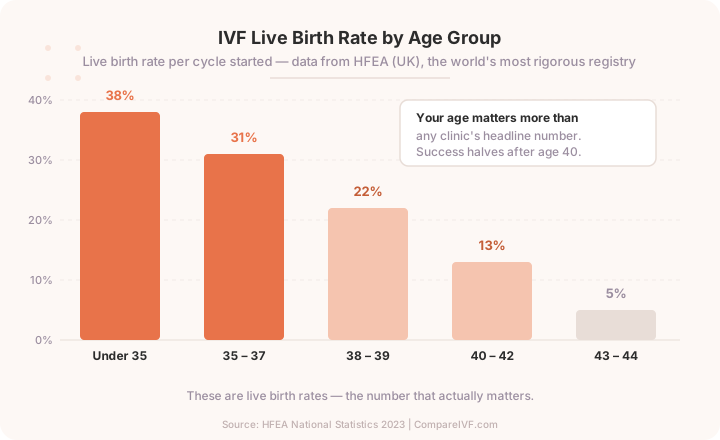
- Under 35: 38% live birth rate per cycle. Best odds. If you are in this group, IVF has a strong chance of working within 2–3 cycles.
- 35–37: 31%. Still a meaningful chance per cycle. This is the group where time pressure starts to become real.
- 38–39: 22%. The drop accelerates. Three to four cycles may be needed. Donor egg IVF begins to become a serious conversation.
- 40–42: 13%. At this age, many fertility specialists will discuss donor eggs early in the consultation. The difficulty is not the uterus — it is egg quality.
- 43–44: 5%. Very few cycles end in a live birth with own eggs. Donor egg IVF success rates at this age remain high (typically 40–50%) because the limiting factor — egg quality — is removed.
Indian clinics rarely publish age-stratified success rates. Always ask: "What is your live birth rate for patients in my age group?"
Why Multiple Cycles Change the Math
A single cycle's odds only tell part of the story — what changes the picture is how those odds compound across attempts. A large UK cohort study of over 150,000 women, published in JAMA, found that for women under 40, a 32% chance in the first cycle builds to a 68% cumulative chance of a live birth by the sixth cycle. For women aged 40–42, a 12% first-cycle chance builds to roughly 32% cumulative by the sixth cycle. Above 42, per-cycle rates stayed under 4% throughout, and cumulative outcomes remain low even across several attempts.
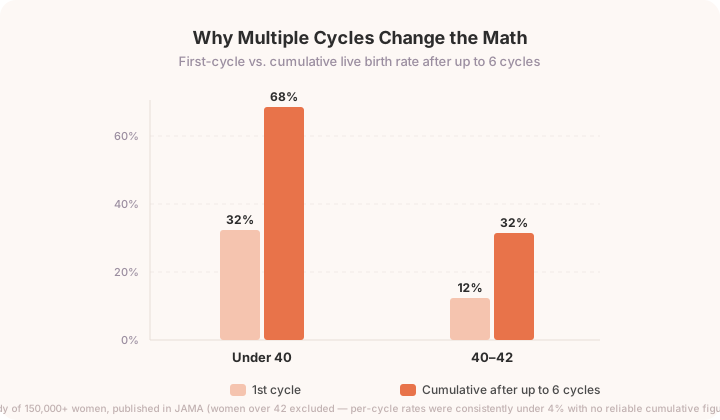
This is also why realistic budgeting matters as much as realistic expectations — most patients plan for one cycle when the honest number is closer to two or three, and that difference in planning is entirely explained by the chart above.
Why Does Age Matter So Much?
Women are born with all the eggs they will ever have. As a woman ages, her egg count declines and — more critically — egg quality declines. Older eggs are more likely to have chromosomal abnormalities, which means they are less likely to fertilise, less likely to develop into a healthy embryo, less likely to implant, and more likely to miscarry.
Does Male Age Matter Too?
Less than female age, and the evidence is genuinely mixed rather than settled. Sperm DNA fragmentation — a measure of damage to the genetic material inside sperm — is measurably higher in men over 45 than in men under 30. Some studies link higher fragmentation to lower blastocyst formation and higher miscarriage rates. Other, similarly designed studies have found no significant difference in fertilisation rate, blastocyst formation, or live birth rate by male age group.
The honest summary: male age is a real but secondary factor, worth mentioning to your clinic if the male partner is over 45, but it does not change the treatment plan the way female age does.
What Are Your Options When Success Rates Are Low?
Donor egg IVF uses eggs from a younger donor combined with your partner's sperm. Success rates reset to those of the donor's age group — typically 40–50% per cycle. This is a separate emotional decision, but one worth discussing with your doctor early rather than after several failed cycles.
PGT-A (Preimplantation Genetic Testing) allows embryos to be screened for chromosomal normality before transfer. In older patients, most embryos are abnormal — PGT-A helps identify the healthy ones, reducing the number of failed transfers. It adds ₹50,000–1,00,000 to the cost of a cycle, but can reduce the number of failed cycles.
The Time Factor: Why Waiting Has a Cost
Every year after 35 meaningfully changes the odds. A patient who delays starting IVF by one year at age 37 is not the same patient — biologically — as when she was 36. Clinics sometimes recommend extended diagnostic phases, multiple IUI cycles, or conservative protocols. These can be appropriate in younger patients, but in patients over 38, time is itself a clinical factor.
If you are under 35 with a straightforward diagnosis, a few cycles of IUI before IVF is often the medically appropriate first step. If you are 38 or older, ask your fertility doctor directly: "Given my ovarian reserve and my age, how many cycles should we attempt with my own eggs before discussing alternatives?" Get a clear answer, and be wary of a treatment plan that doesn't factor in the time cost.
The best clinic in India cannot overcome biology. But understanding the real numbers for your age group helps you make faster, better decisions.
The Bottom Line
Age is the single biggest factor in your realistic odds — bigger than the clinic, the doctor, or the protocol. Indian clinics that advertise a single flat "success rate" without mentioning age are using a number that means very little on its own. Ask for the number specific to your age group, understand how it compounds over multiple cycles, and use that — not a billboard — to plan your treatment, budget, and timeline.
Frequently Asked Questions
Does AMH level matter as much as age?
AMH (a marker of ovarian reserve) affects how many eggs a stimulation cycle is likely to produce, but age remains the stronger predictor of egg quality — the two are related but not interchangeable. A low AMH at 32 and a low AMH at 42 do not carry the same odds.
Can lifestyle changes improve success rates at any age?
Diet, weight, smoking cessation, and reducing alcohol can meaningfully improve outcomes at any age, but they cannot reverse the age-related decline in egg quality itself. They help you make the most of the odds your age gives you — they do not change what those odds are.
Is it worth trying with my own eggs if my odds are low?
That's a personal and clinical decision, not just a statistical one. Many patients attempt one or two cycles with their own eggs even at low predicted odds, then reassess. What matters is going in with the real number, not an inflated one, so the decision is genuinely informed.
Want a realistic, age-specific assessment of your options? Book a free consultation with our fertility advisors.
About CompareIVF Editorial Team
The CompareIVF editorial team combines fertility medicine expertise with investigative journalism to help patients make informed decisions about their fertility journey.