Is IVF Covered by Health Insurance in India? The Complete 2026 Guide
IVF in India costs ₹1.5–4 lakh per cycle. Over the course of a typical fertility journey — two to three cycles — the total outlay can reach ₹5–12 lakh. For most Indian families, this is a significant financial burden. So the first question many couples ask is: will my insurance pay for any of this?
The honest answer is: probably not, but check carefully. The landscape is more nuanced than a simple yes or no.
Why Most Standard Policies Exclude IVF
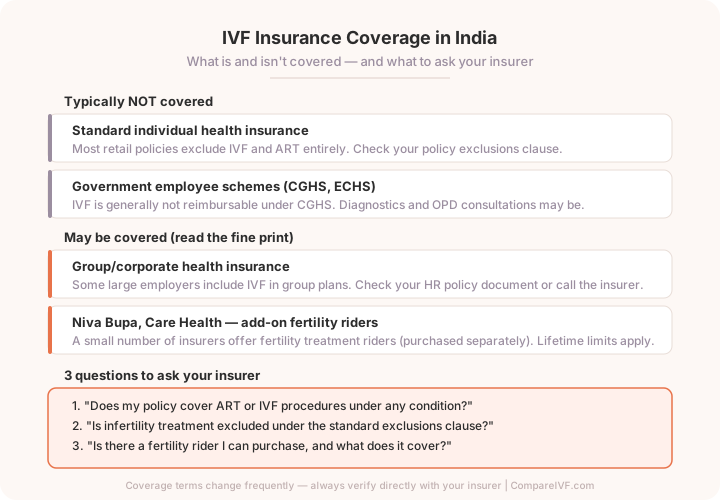
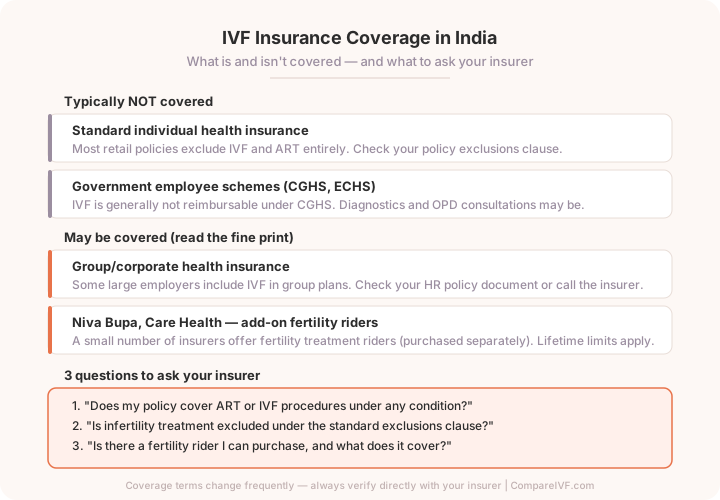
Most retail individual and family health insurance plans in India explicitly exclude "fertility treatment," "assisted reproductive technology," or "IVF/ART procedures" under the standard exclusions clause. This is standard across most public and private insurers including Star Health, HDFC Ergo, New India Assurance, and United India.
The reasoning insurers use is that infertility is classified as a chronic or pre-existing condition in most policy frameworks, and that IVF is an elective rather than emergency treatment. This classification is increasingly contested in medical and legal circles, but it reflects current practice.
Corporate and Group Insurance: A Different Story
Group health insurance policies — provided by employers — operate under different terms. Some large employers, particularly in the technology, banking, and pharmaceutical sectors, include fertility treatment coverage in their group plans. This is especially true for companies with significant international operations or global benefits benchmarking.
If you are covered under a group corporate policy, do not assume it doesn't cover IVF — check the actual policy document or call your HR team. Some policies provide ₹1–3 lakh of IVF coverage as part of a women's health or family planning benefit, subject to lifetime limits.
Fertility Riders and Add-On Covers
A small number of insurers in India have introduced fertility treatment riders or add-on covers that can be purchased separately. Niva Bupa (formerly Max Bupa) and Care Health have offered such products at various times. These typically cover one to two cycles of IVF, with strict eligibility criteria (age, years of infertility, diagnostic workup required) and lifetime benefit limits of ₹1–2 lakh.
These riders have to be purchased before infertility is diagnosed — you cannot add them once you have a documented infertility condition.
Always call your insurer directly and ask: "Is IVF or ART covered under my current policy, or is there a fertility rider I can add?" Do not rely on policy summaries — read the exclusions clause.
What Is Typically Covered (Even When IVF Isn't)
Even if your policy excludes IVF, it may cover: the diagnostic workup (blood tests, semen analysis, ultrasounds), specialist consultations as OPD, laparoscopy or hysteroscopy if performed for a diagnosed condition (e.g. endometriosis, polyp removal), and hospitalisation if you develop OHSS requiring admission.
These components can amount to ₹30,000–80,000 — not insignificant. File claims for everything that is covered, even if the IVF cycle itself is not.
Government Employee Schemes (CGHS, ECHS)
IVF is generally not reimbursable under CGHS (Central Government Health Scheme) or ECHS (military). These schemes cover OPD consultations and investigations at empanelled hospitals, but ART procedures are excluded. Some CGHS-empanelled hospitals do offer fertility consultations, which may be partially covered.
The Bottom Line
Do not assume your insurance covers IVF, and do not assume it doesn't. Call your insurer, read your exclusions clause, ask your employer if you have a group policy, and check whether any fertility rider is available to purchase. Even partial coverage can meaningfully reduce the financial burden of a fertility journey.
About CompareIVF Editorial Team
The CompareIVF editorial team combines fertility medicine expertise with investigative journalism to help patients make informed decisions about their fertility journey.