
IVF Babies: Are They Healthy? What 40 Years of Research Shows
Louise Brown, the world's first IVF baby, was born in 1978. She is now in her 40s, healthy, and has children of her own — conceived naturally. Over 10 million IVF babies have been born since then. They have been studied, followed, and tracked across their entire lifetimes by some of the world's most rigorous researchers.
The question — are IVF babies healthy? — has a clear, evidence-based answer. And it is almost entirely reassuring.
Cognitive Development and Intelligence
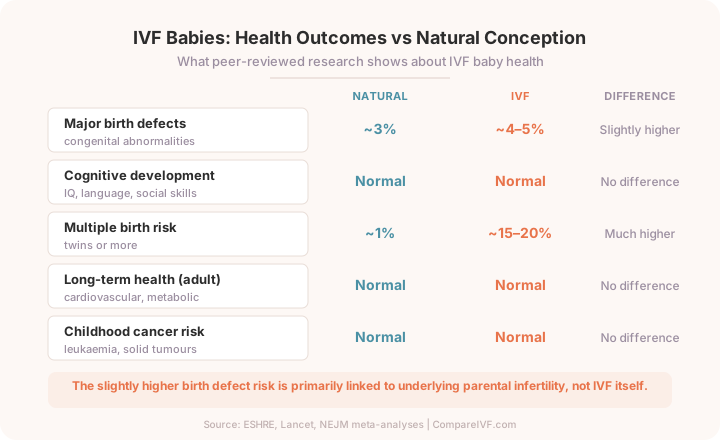
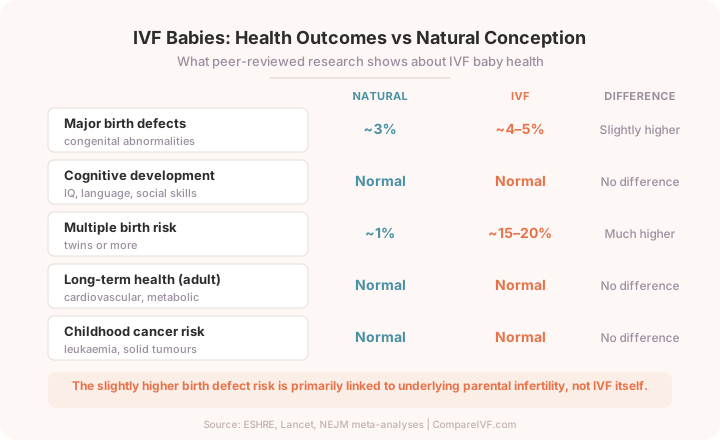
Multiple large-scale studies, including a major Swedish cohort of over 2.5 million children, have found no difference in cognitive development between IVF and naturally conceived children. IVF babies score equivalently on IQ tests, language development assessments, educational achievement, and neurological development markers. This holds across all ages studied, from infancy through adulthood.
Long-Term Physical Health
Studies following IVF children into adulthood have found no meaningful difference in cardiovascular health, metabolic health, or cancer rates. Early research suggested possible small differences in blood pressure — these have not been consistently confirmed in larger, more recent studies. The current scientific consensus is that IVF children have normal long-term physical health.
Birth Defects: A Nuanced Picture
The one area where the data shows a modest difference is birth defects. Major birth defects occur in approximately 3% of naturally conceived babies. In IVF babies, this figure is slightly higher — approximately 4–5%. This sounds alarming until you understand the context.
A significant portion of this difference disappears when researchers control for parental age and the underlying cause of infertility — many of the factors that cause infertility also independently increase the risk of birth defects. The IVF procedure itself does not appear to be the primary driver. When the comparison is made between fertile couples who conceived after trying for over 12 months (suggesting underlying subfertility) and IVF patients, the difference largely disappears.
The slightly elevated birth defect rate in IVF babies appears to be primarily related to parental factors — age and underlying infertility — not the IVF procedure itself.
The Twin Problem
The one area where IVF does carry a meaningful health risk is multiple pregnancy. When two embryos are transferred, the chance of twins rises to 15–25%. Twin pregnancies are riskier than singleton pregnancies for both mother and babies: higher rates of premature birth, low birth weight, and NICU admission.
The solution is elective single embryo transfer (eSET) — transferring one high-quality embryo at a time. Success rates with eSET from a good-quality blastocyst are nearly equivalent to double embryo transfer. Many progressive Indian clinics have moved to eSET as their standard protocol. Ask your clinic what their policy is.
Emotional and Social Development
IVF children grow up in families where they were deeply wanted — often after years of trying. Research consistently shows that IVF families have warm, close parent-child relationships. There is no evidence of elevated rates of psychological problems, social difficulties, or emotional challenges in IVF children. In some studies, parent-child relationships in IVF families score higher on warmth and communication than in spontaneously conceived families.
The Bottom Line
Four decades of evidence is clear: IVF babies develop into healthy children and healthy adults. The procedure does not meaningfully increase the risk of the outcomes that parents fear most — developmental problems, childhood illness, or cancer. The small elevated risk of birth defects is largely explained by parental factors, not the IVF procedure. The biggest modifiable risk factor in IVF is multiple pregnancy — and that is within your control by discussing single embryo transfer with your clinic.
About CompareIVF Editorial Team
The CompareIVF editorial team combines fertility medicine expertise with investigative journalism to help patients make informed decisions about their fertility journey.