
Free IVF in India: Government Schemes and Public Hospitals That Can Help
For a large proportion of Indian families, the cost of IVF is not just a burden — it is an insurmountable barrier. At ₹1.5–4 lakh per cycle, a treatment that may require multiple attempts is financially out of reach for anyone outside the upper-middle class.
But there are options. Several state governments, public medical colleges, and central institutions offer IVF at dramatically reduced cost — or, in some cases, for free. This guide documents what is available, where, and how to access it.
Rajasthan: Free IVF for BPL Families
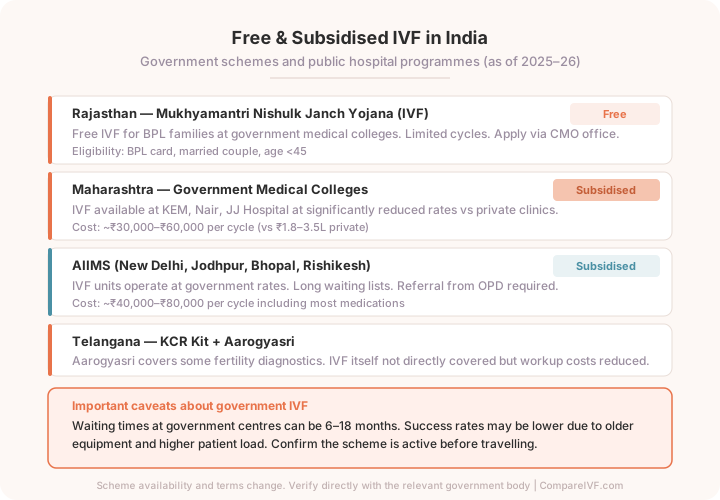
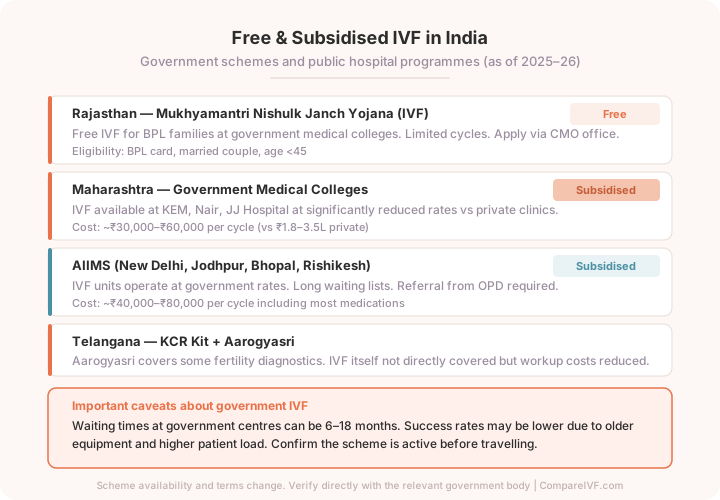
Rajasthan is one of the few states with a specific scheme for free IVF. Under the Mukhyamantri Nishulk Janch Yojana's expanded scope, IVF is available at no cost for Below Poverty Line (BPL) families at government medical colleges including SMS Medical College Jaipur and JK Lon Hospital. The scheme has limited cycles available per year, so there is a waiting list.
Eligibility: BPL ration card holder, married couple, woman under 45. Apply through the Chief Medical Officer (CMO) office of your district. Bring your BPL card, marriage certificate, and relevant fertility investigation reports.
AIIMS: Subsidised IVF at Central Institutions
All India Institute of Medical Sciences (AIIMS) operates dedicated IVF units at several campuses — New Delhi, Jodhpur, Bhopal, Rishikesh, and others. Costs are a fraction of private clinics: approximately ₹40,000–₹80,000 per cycle including most medications. Equipment is modern, staff are highly trained, and procedures meet national standards.
The significant limitation is waiting time. AIIMS New Delhi's fertility unit can have waiting lists of 12–18 months for IVF. For patients where time is a critical factor — particularly women over 38 — this delay has real biological consequences. Discuss this tradeoff carefully.
To access AIIMS: get a referral from a general physician, obtain an OPD appointment (available online via the AIIMS appointment portal), attend the fertility clinic consultation, and you will be registered for treatment.
Maharashtra: Government Medical Colleges
Maharashtra's major government hospitals — KEM Hospital, Nair Hospital, and JJ Hospital in Mumbai; Sassoon Hospital in Pune; and Government Medical College Nagpur — all have obstetrics and gynaecology departments with fertility units. IVF is performed at heavily subsidised rates, typically ₹30,000–₹60,000 per cycle.
These hospitals also serve as training centres for fertility specialists. Procedures are supervised by senior faculty. Waiting times are shorter than AIIMS — typically 3–6 months. The infrastructure is older than private clinics but meets clinical standards.
Other Government Options Across India
Karnataka: Indira Gandhi Institute of Child Health, Bangalore, and Bowring and Lady Curzon Hospital both offer fertility services at reduced rates, though IVF availability varies. Andhra Pradesh and Telangana: NIMS Hyderabad offers IVF through its obstetrics department. Tamil Nadu: Government Rajaji Hospital Madurai and Stanley Medical College Chennai have fertility units. Check availability directly, as services and waiting times change.
Important Caveats About Government IVF
Government fertility centres are not the same as private clinics in terms of patient experience. Waiting rooms are crowded. Appointments can be delayed. The doctor-patient communication time is limited. Success rates may be lower than private clinics — partly because government centres see higher proportions of complex, delayed-presentation cases.
The clinical standard of care at AIIMS and major government medical colleges is genuine and high. The infrastructure is the main limitation, not the expertise.
If you are considering a government IVF programme, factor in the waiting time against your age. A 37-year-old who waits 12 months is a 38-year-old starting treatment. This is a real biological cost.
NGOs and Charitable Fertility Support
Several NGOs in India provide financial assistance for fertility treatment. iCall, the Infertility Support Network, and some fertility-focused trusts offer partial grants or low-interest loans for IVF. Speak to your clinic's counsellor about what support organisations are available in your city.
The Bottom Line
Free or subsidised IVF is available in India. It requires patience, documentation, and realistic expectations about waiting times. For patients who cannot access private care, these routes are genuine and clinically credible. For patients where time is a factor — particularly women approaching 38 — the waiting list itself needs to be weighed against the biological cost of delay.
About CompareIVF Editorial Team
The CompareIVF editorial team combines fertility medicine expertise with investigative journalism to help patients make informed decisions about their fertility journey.